Laparoscopic Right Hemilcolectomy: A Comprehensive Guide### Introduction
Laparoscopic Right Hemilcolectomy is a minimally invasive surgical procedure used to remove the right portion of the colon. This procedure is often recommended for patients with conditions such as colorectal cancer, polyps, or Crohn's disease affecting the right side of the colon. This guide aims to provide detailed information about the procedure, its benefits, the preparation involved, and what patients can expect during recovery.
Laparoscopic Right Hemilcolectomy involves the removal of the right side of the colon using small incisions and a camera. This technique is less invasive compared to traditional open surgery, leading to faster recovery times and reduced postoperative pain.
Why is it Used?
This procedure is primarily used to treat:
- Colorectal Cancer: When cancer is located in the right side of the colon.
- Crohn's Disease: To remove diseased sections of the colon.
- Polyps: Large or numerous polyps that cannot be removed through colonoscopy.
When is it Recommended?
A laparoscopic right hemilcolectomy is recommended when:
- There is a diagnosis of cancer in the right colon.
- Non-cancerous conditions like Crohn's disease require surgical intervention.
- Polyps are too large or numerous for endoscopic removal.
When is it Not Appropriate?
This procedure may not be suitable for:
- Patients with extensive abdominal adhesions from previous surgeries.
- Individuals with certain medical conditions that increase surgical risks.
- Cases where cancer has spread extensively beyond the colon.
How Does it Work?
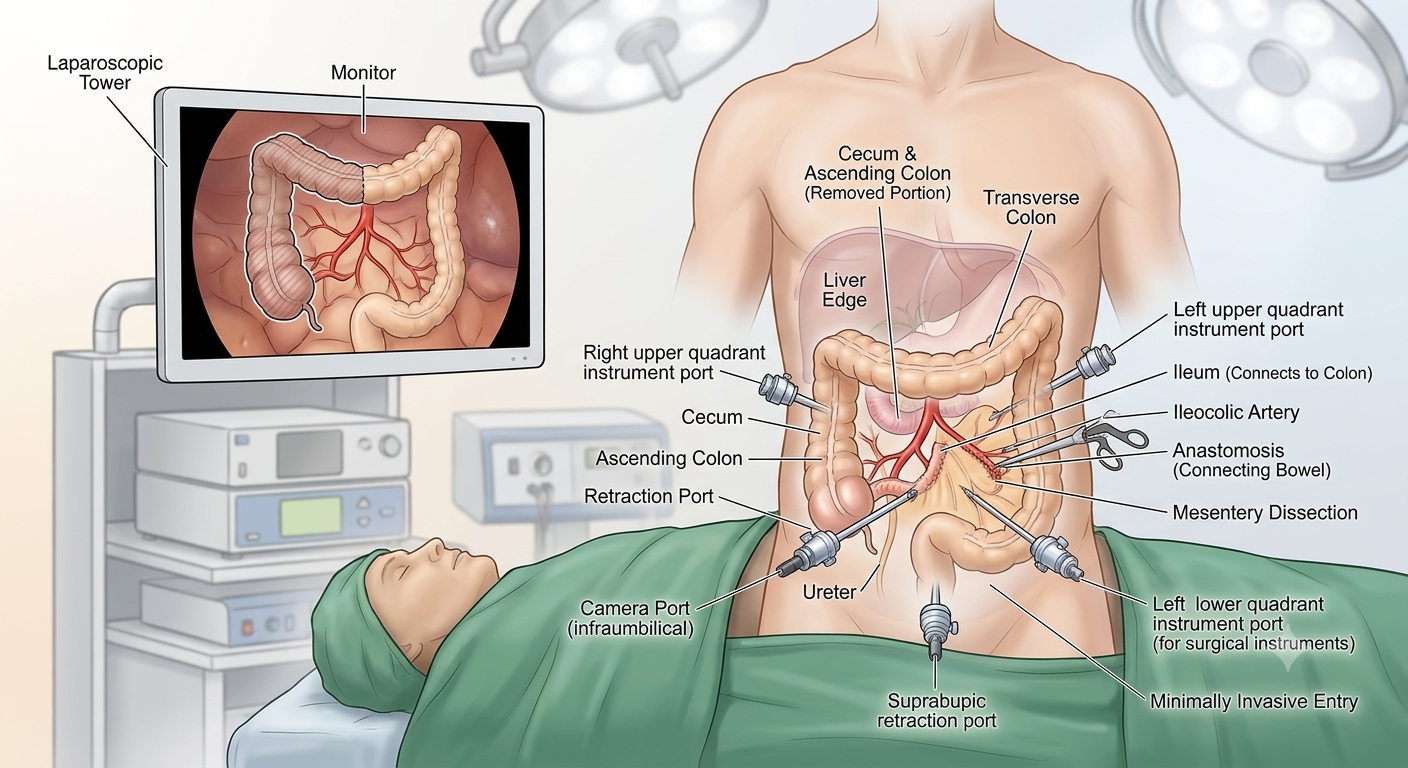
During the procedure, the surgeon makes several small incisions in the abdomen. A laparoscope (a thin tube with a camera) is inserted through one of the incisions, allowing the surgeon to view the colon on a monitor. Surgical instruments are inserted through the other incisions to remove the affected portion of the colon.
What Happens During the Procedure?
1. Anesthesia: The patient is placed under general anesthesia.
2. Incisions: Small incisions are made in the abdomen.
3. Laparoscope Insertion: A camera is inserted to guide the surgery.
4. Colon Removal: The right side of the colon is detached and removed.
5. Closure: The remaining sections of the colon are reattached, and incisions are closed.
Preparation
Patients are advised to:
- Follow a special diet a few days before surgery.
- Avoid eating or drinking after midnight before the surgery.
- Stop certain medications as advised by the doctor.
Risks & Complications
While generally safe, potential risks include:
- Infection at the incision sites.
- Bleeding or injury to surrounding organs.
- Anastomotic leak (leakage where the colon is reconnected).
What to Expect After the Surgery
- Hospital Stay: Usually 3-5 days.
- Recovery Time: Full recovery may take 4-6 weeks.
- Diet: Gradual reintroduction of solid foods as tolerated.
Outcomes
Patients can expect:
- Relief from symptoms caused by the diseased section of the colon.
- Improved quality of life.
- Regular follow-ups to monitor recovery and check for recurrence in cancer cases.
Alternatives
- Open Surgery: May be necessary if laparoscopic surgery is not feasible.
- Endoscopic Procedures: For smaller polyps or lesions.
- Medication: For managing symptoms in non-cancerous conditions.
About Dr. Vishu Jain
Dr. Vishu Jain is a Consultant in GI, HPB, Laparoscopic, and Liver transplant surgery with extensive experience in minimally invasive procedures. His expertise in laparoscopic and robotic surgeries ensures high-quality care and improved patient outcomes.
Consultation-Next-Step
For more information or to discuss your treatment options, please consult a specialist. Dr. Vishu Jain is available for consultations at Gastrocare Hospital, Bhopal.
1. How long does the surgery take?
The procedure typically takes 2-4 hours, depending on the complexity.
2. Will I have visible scars?
The incisions are small, usually resulting in minimal scarring.
3. Can I resume normal activities after surgery?
Most patients can resume normal activities within 4-6 weeks, but this may vary based on individual recovery.
4. Are there dietary restrictions post-surgery?
Patients are advised to follow a soft diet initially and gradually reintroduce solid foods.
5. How often are follow-up visits required?
Follow-up visits are typically scheduled a few weeks after surgery and then periodically to monitor recovery.
Visit Dr. Vishu Jain
Bhopal
Phone: +917838948761
WhatsApp: 7838948761
Email: dr.vishujain@gmail.com
Have a question for Dr. Vishu Jain?
Reach out and the clinic will get back to you.
Get in touch